

You started your business to serve customers, not to chase receipts. Yet between invoices, payroll, expenses, and bank statements, the books keep slipping down the to-do list, and you find yourself asking: should I hire a bookkeeper or an accountant?
Here is the short version. A bookkeeper generally maintains and organizes your day-to-day financial records. An accountant may interpret those records, prepare financial reports, assist with tax-related work, and provide broader financial analysis. Responsibilities vary by provider, qualifications, and engagement, and many businesses benefit from both.
Quick answer: Hire a bookkeeper when your day-to-day records are late, messy, or inconsistent. Hire an accountant when you need tax work from a qualified professional, help interpreting your numbers, or year-end support. Hire both when transactions are steady and your financial decisions are getting more complex.
The best choice depends on your transaction volume, the condition of your records, your reporting requirements, and your budget. This guide explains the differences, what hiring typically costs, and how to decide.
What Is the Difference Between a Bookkeeper and an Accountant?
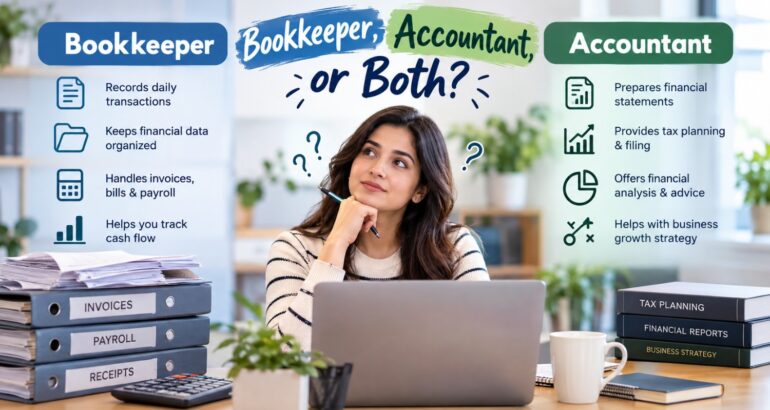
A bookkeeper records and organizes what happened in your business. An accountant helps you understand what it means. Bookkeeping keeps records accurate and current; accounting builds on those records to review performance, prepare reports, and support decisions.
Bookkeepers typically handle:
- Day-to-day financial recordkeeping
- Recording and categorizing transactions
- Bank and credit card reconciliation
- Accounts payable (bills you owe) and accounts receivable (money customers owe you)
Accountants may handle:
- Preparing and reviewing financial statements
- Reviewing financial performance and profitability
- Tax preparation and tax planning, where qualified
- Budgeting and financial analysis
These roles overlap. Some bookkeepers prepare monthly financial statements, and some accountants also do bookkeeping. Not every accountant provides tax services, and not every bookkeeper offers the same level of financial reporting.
Also, “accountant” does not mean “CPA.” A Certified Public Accountant is a specific professional designation in the United States, licensed by a state. Some accountants are CPAs; many are not.
| Factor | Bookkeeper | Accountant |
|---|---|---|
| Main role | Maintains accurate day-to-day records | Interprets records and supports decisions |
| Typical tasks | Categorizing transactions, reconciliations, payables and receivables, invoice tracking | Statement review, performance analysis, budgeting, tax work if qualified |
| Reports | Routine reports, depending on the agreement | Prepares and explains financial statements |
| Tax involvement | Keeps records organized for tax time | May prepare returns and plan taxes, depending on credentials |
| Typical rhythm | Weekly or monthly | Monthly, quarterly, or annually |
| Best for | Keeping the books current | Understanding results and planning ahead |
Want a deeper look at the two functions? Read XS4FM’s guide to the difference between accounting and bookkeeping.
What Does a Bookkeeper Do for a Small Business?
A bookkeeper keeps your financial records accurate and up to date. Common responsibilities include:
- Recording business income and expenses
- Categorizing transactions
- Reconciling bank and credit card accounts
- Managing accounts payable and receivable
- Tracking invoices and customer payments
- Organizing records for tax preparation
- Preparing or supporting routine financial reports, depending on the service agreement
- Keeping bookkeeping records current
Reliable bookkeeping shows you where the business stands: what you have earned, what you owe, and what is still unpaid. It also gives your accountant better records to work with. For more detail, see XS4FM’s complete guide to bookkeeping services for small businesses in the USA.
Ready to get your books organized? Explore XS4FM’s bookkeeping services for US businesses and contact our team to discuss the support your business needs.
What Does an Accountant Do for a Small Business?
An accountant turns organized records into insight. Depending on qualifications and your agreement, an accountant may:
- Review financial records
- Prepare and interpret financial statements
- Support tax preparation and tax planning, where qualified
- Analyze business performance and identify financial trends
- Support budgeting and forecasting
- Advise on financial decisions
- Help you understand profitability and financial risks
Scope depends on the accountant’s credentials and your engagement. Not every accountant is a CPA, and not every accountant prepares tax returns. According to the IRS, CPAs, enrolled agents, and attorneys have unlimited rights to represent taxpayers before the IRS, and all paid preparers need a Preparer Tax Identification Number (PTIN). If tax work matters to you, ask about credentials up front.
Accounting also depends on bookkeeping. When the underlying records are incomplete, even a skilled accountant has to spend time (and your budget) fixing them before analyzing them.
Should I Hire a Bookkeeper or an Accountant for My Small Business?
Do I need a bookkeeper or an accountant? Start with your most urgent problem. A bookkeeper solves recordkeeping problems; an accountant addresses interpretation, tax, and reporting needs.
When to Hire a Bookkeeper
- Transactions are not being recorded consistently.
- Bank and credit card accounts need reconciliation.
- Invoices, bills, and expenses are difficult to track.
- Your financial records are behind.
- You need dependable monthly recordkeeping.
When to Hire an Accountant
- You need tax preparation or tax planning from a qualified professional.
- Your financial statements need interpretation.
- You want help understanding profitability or financial performance.
- Your business faces complex reporting or financial decisions.
- You need year-end accounting support.
When You May Need Both
- You need ongoing transaction management plus periodic financial analysis.
- You want accurate records all year and professional support with tax and year-end requirements.
- Your company is growing and its financial needs are becoming more complex.
A Simple Decision Checklist
Which statements sound like you?
- “I can’t remember the last time my accounts were reconciled.” → bookkeeping need
- “I’m behind on categorizing transactions or tracking invoices.” → bookkeeping need
- “My books are current, but I don’t know what my statements are telling me.” → accounting need
- “I need a qualified professional for my tax return or tax planning.” → accounting or tax-professional need
- “My books are in good shape and I’m weighing hiring, pricing, or funding decisions.” → accounting need
- “Both the first two and the last three describe me.” → you likely need both
Still wondering whether to handle it yourself? See XS4FM’s guide, Should You Hire a Bookkeeper or Do It Yourself? New business owners may also like Bookkeeping for Startups.
How Much Does It Cost to Hire a Bookkeeper vs. an Accountant?
There is no single price, and neither option is always cheaper. The cost of hiring a bookkeeper or the cost of hiring an accountant depends mainly on:
- Business size and transaction volume
- Complexity of your financial records
- Frequency of service (monthly versus one-time)
- Number of bank and credit card accounts
- Payroll, invoicing, and accounts payable requirements
- Tax return complexity
- Professional qualifications and level of advisory support
- In-house employee versus outsourced provider
Here are credible reference points. They are market benchmarks, not quotes, and they measure different things:
| Figure | What it measures | Source |
|---|---|---|
| About $300+ per month | Typical starting point for small business bookkeeping | NerdWallet (updated March 2026) |
| About $200 to $700+ per month | Flat monthly packages from online bookkeeping services | NerdWallet |
| About $43 per hour (some $80+) | Average freelance bookkeeping rate on Upwork | NerdWallet |
| $23.66 per hour / $49,210 per year | Median employee wage, bookkeeping, accounting, and auditing clerks, May 2024 | BLS data cited by NerdWallet |
| $39.27 per hour / $81,680 per year | Median employee wage, accountants and auditors, May 2024 | BLS |
The last two rows are employee wages. They exclude benefits, payroll taxes, software, and management time, so they are not what a business pays a firm. NerdWallet also notes that cleanup projects are often priced per project rather than monthly. Accountant fees vary by credentials, location, and scope, so rather than rely on a generic range, ask for a written scope and quote.
Outsourcing can add flexibility if you do not need a full-time employee, because you can adjust scope as your needs change. Whether it costs less depends on your volume and the provider, so compare written scopes rather than headline prices. XS4FM’s comparison of online bookkeeping vs. an in-house bookkeeper can help.
Not sure which level of financial support makes sense for your business? Contact XS4FM to discuss your bookkeeping and financial management requirements.
Can a Small Business Use Both a Bookkeeper and an Accountant?
Yes, and it is common. The bookkeeper keeps records current all year. The accountant uses those records for review, planning, and, where qualified, tax work.
Illustrative example (not a real XS4FM client): A four-person design studio sends receipts and bank feeds to a bookkeeper every month. The bookkeeper categorizes transactions, reconciles accounts, and delivers monthly reports. Each quarter, the owner reviews results with an accountant. At year-end, the accountant or a separate tax professional prepares the return from organized records instead of a shoebox of receipts.
The benefits are coordinated records, clearer responsibilities, and fewer last-minute recordkeeping problems. Tell each professional who the other is, and agree on the accounting software, the year-end cutoff, and who answers which questions.
As a business grows, the questions often shift to cash flow forecasting, budgeting, and growth planning. Some owners add virtual CFO services for financial planning and forecasting support. That is a different role from routine bookkeeping or tax preparation, and XS4FM explains the difference in Virtual CFO vs. Fractional CFO.
Is Outsourced Bookkeeping or Accounting Right for Your Business?
Outsourcing means engaging an external provider instead of hiring an employee. It often suits startups, online sellers, agencies, and growing businesses that need dependable monthly support without a full-time salary or an in-house finance team. Before choosing outsourced bookkeeping services or outsourced accounting services, evaluate:
- Remote collaboration: how you will share documents and ask questions
- Flexible scope: which tasks are included and which cost extra
- Monthly support: ongoing arrangements versus one-time projects such as cleanup
- Access to organized records: the reports and statements you will receive
- Secure document handling: who can see your files and how they are protected
- Communication and reporting: response times and report frequency
Outsourcing is not automatically better. An in-house employee may suit a business with very high daily volume or workflows that need someone on site. To weigh the case for outsourcing, read XS4FM’s 10 benefits of outsourcing bookkeeping, and online sellers can see its e-commerce bookkeeping guide.
About XS4FM: According to its website, XS4FM provides virtual bookkeeping services for small businesses, startups, agencies, and nonprofits, including transaction recording and categorization, bank and credit card reconciliation, accounts payable and receivable tracking, expense tracking, payroll reconciliation support, and regular financial reports. It also lists accounts payable and receivable services, payroll processing, budgeting and forecasting, and virtual CFO services. On security, XS4FM says it uses Microsoft SharePoint with controlled access and multi-factor authentication; read its data security page and ask any questions before sharing documents.
Why Accurate Bookkeeping Matters Before Tax Season
Current books make it easier to organize information for tax preparation and financial review. They do not eliminate tax problems or guarantee compliance, but they can reduce avoidable last-minute scrambling. Good bookkeeping helps you:
- Keep income and expense records organized
- Reconcile bank and credit card statements so gaps show up early
- Identify missing transactions before a deadline forces the issue
- Retain supporting documents such as receipts, invoices, and statements
- Prepare clear information for a qualified tax professional
How long to keep records depends on the document. The IRS explains that retention depends on the action, expense, or event a record supports, and NerdWallet notes that tax returns and supporting records are generally kept three years, with employment tax records at four. Confirm your own timelines with your tax professional.
If your books are months behind, do not wait for the filing deadline. XS4FM’s catch-up bookkeeping services are designed to bring overdue financial records up to date by reviewing historical transactions, reconciling accounts, and identifying discrepancies. XS4FM notes that it focuses on bookkeeping and does not provide tax preparation guarantees, so plan to pair clean books with a qualified tax professional. For more, read its cleanup and catch-up bookkeeping guide and bookkeeping mistakes small business owners should avoid.
Behind on your books? Learn how XS4FM’s catch-up bookkeeping services may help you bring your financial records up to date.
How to Choose the Right Bookkeeping or Accounting Service
Use this checklist before you sign anything:
- Identify the work you need done. List the tasks you are dropping: reconciliations, invoicing, reports, tax, forecasting.
- Decide what kind of support you need. Ongoing bookkeeping, accounting, tax support, or a combination.
- Ask what deliverables are included. For example, monthly statements and reconciled accounts.
- Confirm how often you will receive financial reports.
- Ask who will handle your records and how documents are protected.
- Confirm software compatibility and communication arrangements.
- Understand pricing, additional fees, and engagement terms.
- Verify relevant experience and professional qualifications. This matters most for tax work.
- Ask how the provider will coordinate with your tax professional, if you use one.
If you would like a second opinion on where your books stand, contact XS4FM. Its team can talk through your records, your reporting needs, and which bookkeeping or financial management service fits, so you can choose with confidence.
Frequently Asked Questions
Should I hire a bookkeeper or an accountant first?
Usually a bookkeeper first if your records are behind, inconsistent, or unreconciled, because accountants and tax professionals depend on accurate records. If your books are already current and you need tax planning or help interpreting results, an accountant may come first.
Can a bookkeeper prepare financial statements?
Often, yes. Many bookkeepers prepare routine reports such as a profit and loss statement and balance sheet, depending on their skills and your agreement. Audits and certain other regulated services generally require appropriately licensed professionals.
Do small businesses need both a bookkeeper and an accountant?
Many benefit from both, though not necessarily as two employees. A common setup is outsourced monthly bookkeeping plus periodic work with an accountant or tax professional.
Is a bookkeeper cheaper than an accountant?
Often, but not always. BLS median wages are lower for bookkeeping, accounting, and auditing clerks ($49,210) than for accountants and auditors ($81,680), based on May 2024 data. Wages are not fees, though, and total cost depends on scope, volume, and provider, so compare written scopes.
Can I outsource bookkeeping for my small business?
Yes. Outsourced and virtual bookkeeping are common. Confirm what is included, which software the provider uses, how you will communicate, and how your documents are protected.
When should I hire a professional bookkeeper?
Consider it when your records are behind, reconciliations are overdue, you cannot easily see what customers owe or what bills are due, bookkeeping is eating into your time, or tax season is approaching with disorganized records.
Does a bookkeeper handle taxes?
Usually not. Bookkeepers typically keep records organized for a tax professional rather than prepare or advise on returns, though some hold additional credentials or work within firms that offer tax services. Ask, and remember that paid preparers need a PTIN.
What is the difference between a bookkeeper, accountant, and CPA?
A bookkeeper records and organizes transactions. An accountant analyzes and reports on financial information and may offer tax or advisory services. A CPA is a licensed accounting professional who has met a state’s requirements. Duties vary by provider, credentials, applicable rules, and agreement.
Conclusion: Make the Right Choice for Your Business
Bookkeeping keeps your records accurate and current. Accounting interprets those records and, depending on the provider’s qualifications and scope, adds analysis, reporting, and tax support. The right choice depends on your immediate needs and financial complexity, not on which title sounds more impressive.
If your records are behind, start with bookkeeping. If your books are solid and your questions are about tax or strategy, start with an accountant. If both sound like you, you probably need both.
Your business deserves clear, organized financial records. If you’re looking for bookkeeping support or help understanding your financial management needs, contact XS4FM to discuss the right next step for your business.
You can also explore all of XS4FM’s financial management services or browse more guides on the XS4FM blog.
