

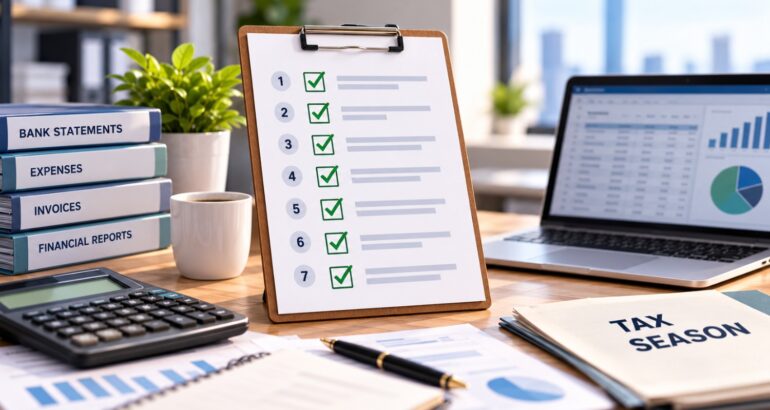
To prepare your business books for tax season, categorize every transaction, reconcile all bank and credit card accounts, review payables and receivables, organize payroll and contractor records, match expenses to receipts, review loans and assets, and run a profit and loss statement and balance sheet. Then hand organized records to your tax professional.
This guide walks through each step, lists the documents to gather, and includes a checklist. It covers bookkeeping only. Tax positions, deductions and filing decisions belong with a qualified US tax professional.
Why do small businesses need organized books before tax season?
Your tax return is built from your books. If income is missing, expenses are miscategorized or accounts do not reconcile, your tax professional has to fix those problems first. That takes longer, costs more and leaves less time to review the return.
Organized books also help you:
- Show the IRS records that support your income and deductions. The IRS explains what to keep in its recordkeeping guidance for small businesses.
- Meet early-year deadlines for contractor and employee forms.
- Answer your tax preparer quickly when they ask for statements.
Key dates for tax year 2026
These dates are for calendar-year businesses filing 2026 returns in 2027. Weekends, extensions and state rules can change them, so confirm yours with your tax professional.
| Date | What is due | Applies to |
|---|---|---|
| January 15, 2027 | Q4 2026 estimated tax payment | Businesses and owners who pay estimated tax |
| February 1, 2027 | Forms W-2 and 1099-NEC (January 31 falls on a Sunday) | Employers and businesses paying contractors |
| March 15, 2027 | Partnership (Form 1065) and S corporation (Form 1120-S) returns | Partnerships, multi-member LLCs taxed as partnerships, S corporations |
| April 15, 2027 | Schedule C filers and calendar-year C corporation returns | Sole proprietors, single-member LLCs, C corporations |
Sources: Acculink CPA business tax deadlines and Jupid 2027 tax calendar.
For payments made in 2026, the federal 1099-NEC reporting threshold rose from $600 to $2,000 per contractor. Your contractor records need to show who was paid how much, so this is a bookkeeping task as well as a tax one.
What happens when your business books are not ready for tax season?
Unprepared books slow down tax preparation and raise the chance of errors, amended filings, missed deadlines, penalties and interest. The problems usually fall into four categories. Our guide to bookkeeping mistakes small business owners should avoid covers more of them.
Missing income and expense records
If deposits or expenses are not recorded, your profit is overstated or understated. Overstating it risks paying more than necessary, and understating it risks reporting less than you earned.
Unreconciled bank accounts
When your books do not match your bank statements, something is missing, duplicated or wrong. Unreconciled accounts are the most common reason tax preparers send books back for cleanup.
Incorrect transaction categorization
Expenses lumped into the wrong category, or personal spending mixed with business spending, make financial statements unreliable and make deductions harder to support.
Missing receipts and supporting documents
If you cannot show what a transaction was for, your tax professional may not be able to include it. The IRS says to keep records as long as they may be needed. For most business tax records that is at least three years, and for employment tax records at least four.
How to prepare your business books for tax season: a step-by-step guide
Start in November or December, not March. If you close December in early January, you have time to fix issues before your preparer’s busy season and before the February 1 information-return deadline. A monthly bookkeeping checklist makes this year-end work much lighter.
Step 1: Review and categorize all business transactions
Go through every income and expense transaction for the year. Assign each to the correct account in your chart of accounts, and clear anything left in an uncategorized or suspense account. Separate personal transactions from business ones so they are not treated as business expenses.
Step 2: Reconcile business bank and credit card accounts
Match your books to each bank and credit card statement for all twelve months. Investigate differences instead of forcing a balance. Watch for duplicates, missing deposits, transfers between accounts and card payments recorded as expenses. For a deeper walk-through of reconciliation work, see our bookkeeping services.
Step 3: Review accounts payable and receivable
List unpaid vendor bills and unpaid customer invoices as of December 31. Confirm that each is recorded in the right period, and flag old or uncollectible items for your tax professional. Clean payables and receivables also give you accurate year-end balance sheet figures. See accounts payable and receivable services.
Step 4: Organize payroll and contractor records
Gather payroll reports, payroll tax deposit records and W-2 information. For contractors, confirm you have a Form W-9 on file and total what you paid each person in 2026. Payments of $2,000 or more generally trigger a 1099-NEC due February 1, 2027, but confirm requirements with your tax professional. If you need help running payroll, see payroll processing.
Step 5: Review business expenses and supporting documents
Match major expenses to receipts, invoices or statements, and store them digitally with consistent names so they are easy to find. Flag large or unusual items, such as equipment, vehicles, travel and home-office costs, so your tax professional can decide how to treat them.
Step 6: Review loans, assets and liabilities
Confirm your balance sheet shows current loan balances, interest paid, owner contributions and draws, and purchases of equipment or other assets. Keep loan statements and asset purchase documents on file. These items affect more than your profit and loss, so do not leave them to the last minute.
Step 7: Generate profit and loss and balance sheet reports
Run a year-end profit and loss statement and a balance sheet, and look for anything that seems off: an expense far higher than usual, a negative balance where one should not exist, or income that does not match your deposits. Your tax professional will usually ask for these two reports first, along with supporting detail. XS4FM also offers financial reporting support if you want help interpreting them.
Are your business books ready for tax season?
XS4FM helps small businesses keep accurate bookkeeping records, reconcile accounts and prepare organized financial reports for their tax professionals. Whether your books need routine maintenance or significant catch-up work, our team can help.
What financial documents should small businesses prepare for tax season?
Gather your financial statements, bank and card statements, payroll and contractor records, loan and asset documents, and receipts for major expenses. Ask your tax professional for their specific list, since requirements vary by entity type.
| Category | Documents to gather |
|---|---|
| Financial reports | Year-end profit and loss statement, balance sheet, general ledger |
| Bank and card records | 12 months of statements, reconciliation reports |
| Income | Sales reports, invoices, 1099-K and 1099-NEC forms you received |
| Expenses | Receipts, vendor invoices, mileage logs, expense reports |
| Payroll | Payroll summaries, W-2 and W-3 data, payroll tax deposit records |
| Contractors | W-9 forms and total paid per contractor |
| Loans and assets | Loan statements, asset purchase records, depreciation schedules if you keep them |
| Prior year | Last year’s tax return and any open notices from the IRS or state |
Small business tax-season bookkeeping checklist
Preparation progress: 0/10
- Categorize all business income and expenses
- Reconcile business bank accounts
- Reconcile credit card statements
- Review accounts payable and receivable
- Organize payroll and contractor records
- Collect receipts and expense documentation
- Review business loans and liabilities
- Prepare profit and loss statement
- Prepare balance sheet
- Share organized financial records with your tax professional
What is the difference between bookkeeping and tax preparation?
Bookkeeping records and organizes your financial transactions throughout the year. Tax preparation uses those records to calculate what you owe, apply tax rules and file returns. Bookkeepers prepare the inputs, and qualified tax professionals make the tax decisions.
| Bookkeeping | Tax preparation | |
|---|---|---|
| What it does | Records, categorizes and reconciles transactions; produces financial reports | Applies tax law to your records, prepares and files returns |
| When it happens | Monthly or ongoing | Annually, with estimated payments in between |
| Typical output | Profit and loss, balance sheet, reconciled accounts | Tax return and related filings |
| Who does it | Bookkeeper | CPA, enrolled agent, tax attorney or other qualified preparer |
XS4FM provides bookkeeping and financial reporting. It is not a substitute for a qualified US tax professional. Send questions about deductions, entity choice, filing obligations and tax positions to a CPA, enrolled agent or tax attorney. For more on how the roles differ, read What Is the Difference Between Accounting and Bookkeeping? and Should I Hire a Bookkeeper or an Accountant?
How can professional bookkeeping help you avoid last-minute tax season stress?
Professional bookkeeping spreads the work across the year. You reconcile and categorize monthly instead of reconstructing twelve months in a few weeks, so year-end is a review of work already done.
That typically means:
- Reconciled accounts every month, so errors are caught while they are easy to trace.
- Consistent categorization, so reports are ready for your tax preparer.
- Current payables, receivables and payroll records, so year-end balances are reliable.
- Catch-up support if you are behind, so old problems do not carry into a new filing season.
If you are weighing whether to hire help or do it yourself, see Online Bookkeeping Services vs. Hiring an In-House Bookkeeper. For budgeting, see what bookkeeping costs in our complete guide to bookkeeping services for small businesses in the USA. To understand how outsourcing works, read 10 Benefits of Outsourcing Bookkeeping for Small Businesses.
How XS4FM helps small businesses keep tax-ready financial records
XS4 Financial Management (XS4FM) provides bookkeeping, financial reporting and related support for businesses across the United States, with more than 10 years of experience. It keeps your records accurate, reconciled and organized so you can give them to your tax professional with confidence.
| Customer problem | Recommended solution | XS4FM service |
|---|---|---|
| Books are months behind | Catch up on transactions | Catch-up bookkeeping |
| Bank balances don’t match | Reconciliation | Monthly bookkeeping |
| Expenses are incorrectly categorized | Review and correction | Bookkeeping cleanup |
| Financial statements are incomplete | Prepare accurate reports | Financial reporting |
| Tax documents are disorganized | Maintain organized financial records | Ongoing bookkeeping |
Because you will be sharing sensitive financial data, you can review XS4FM’s data security approach and FAQs. To discuss your books, contact XS4FM.
Frequently asked questions
When should I start preparing my business books for tax season?
Start in November or December. That gives you time to reconcile accounts, fix categories and collect documents before the February 1 contractor and employee form deadline and before your tax professional gets busy.
What is a tax season bookkeeping checklist?
It lists the bookkeeping tasks that make your records ready for tax filing: categorizing transactions, reconciling accounts, reviewing payables and receivables, organizing payroll and contractor records, collecting receipts, reviewing loans, and preparing a profit and loss statement and balance sheet.
What financial records do small businesses need for taxes?
You generally need financial statements, bank and credit card statements, income records, expense receipts, payroll and contractor records, loan and asset documents, and last year’s return. Your tax professional can tell you exactly what they need for your entity type.
Do I need to reconcile my accounts before filing taxes?
Yes, it is strongly recommended. Reconciliation confirms that your books match your bank and card statements, which makes your income and expense figures more reliable.
Can my bookkeeper file my business tax return?
Only if they are a qualified tax professional who offers that service. Bookkeeping and tax preparation are different services. XS4FM prepares organized books for your tax professional.
What is the difference between bookkeeping and tax preparation?
Bookkeeping records and reconciles transactions throughout the year. Tax preparation applies tax law to those records and files returns.
What is the 1099-NEC deadline and threshold for 2026 payments?
For payments made in 2026, contractors paid $2,000 or more generally need a 1099-NEC, due February 1, 2027. Confirm your situation with a tax professional, including any state requirements.
How long should I keep business tax records?
The IRS says it depends on the record. In general, keep tax records for at least three years and employment tax records for at least four. Some records, such as those for property and certain loss claims, need to be kept longer. Ask your tax professional what applies to you.
What if my books are months behind right before tax season?
Prioritize catch-up work: categorize transactions, reconcile every account and run year-end reports. If you cannot finish in time, tell your tax professional early, since they can advise on options such as extensions. Catch-up bookkeeping can help bring the records current, and our guide to catch-up vs. regular bookkeeping explains the difference.
What should I send my tax professional?
Send your year-end profit and loss and balance sheet, reconciled statements, payroll and contractor summaries, loan and asset records, and supporting documents for large or unusual transactions.
